
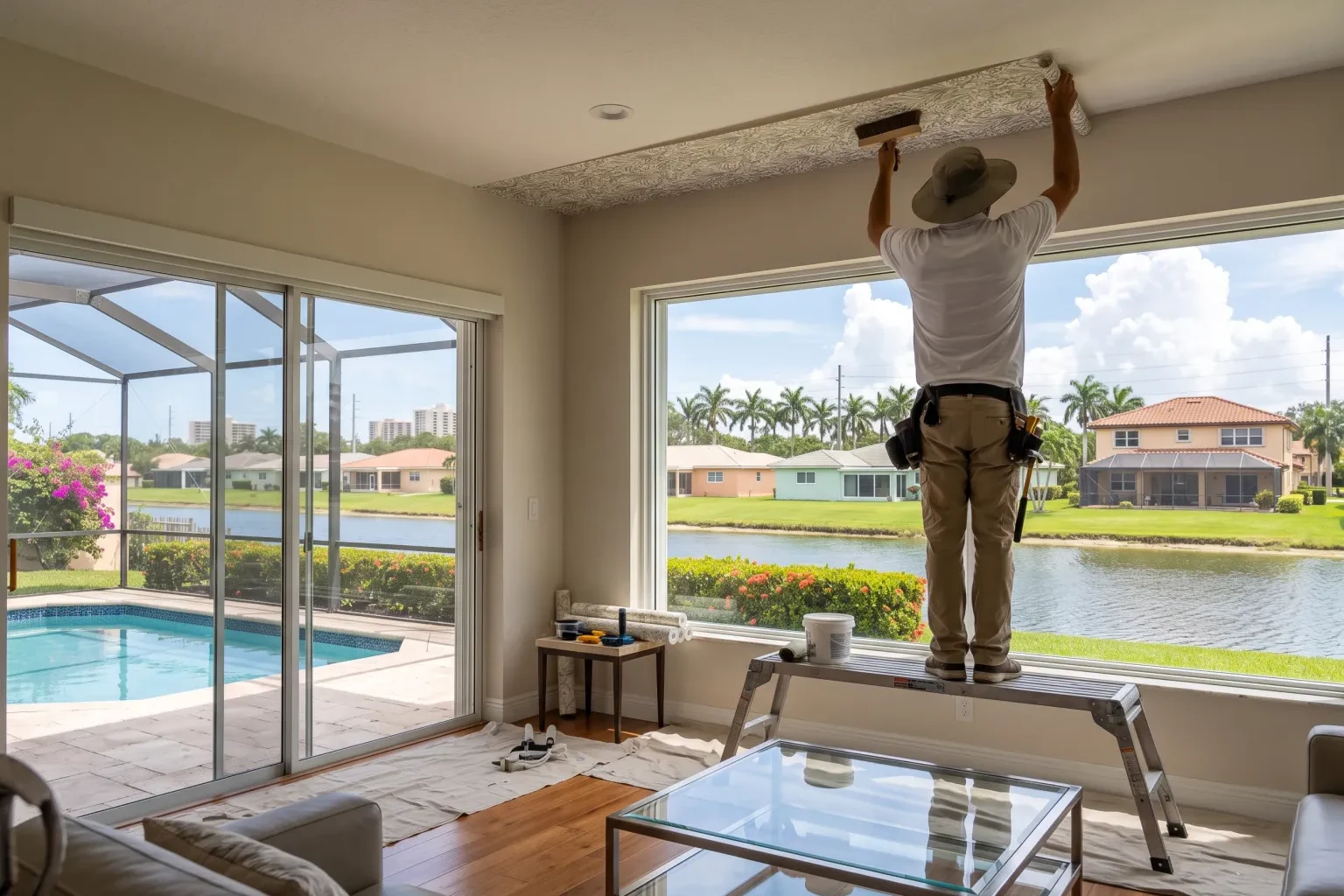
The short answer
Ceiling wallpaper is a good fit when you want a focal point or a more finished room, as long as the ceiling is sound, dry and well ventilated. We repair and prime the surface, plan the layout from a level reference line, match the pattern strip by strip, and trim cleanly at the walls. Cost depends on ceiling condition, paper type, pattern repeat, room size and ceiling height.
A papered ceiling changes how a room feels the moment you walk in. It can warm up a large open space, add interest to a small powder room, or give a bedroom a finished, tailored look that paint alone can't match. Ceiling work is also one of the more demanding wallpaper jobs. Every strip goes on overhead, seams are seen from below in raking light, and the pattern has to line up with walls that are rarely square. Luxury Wallpaper Installer hangs ceiling wallpaper for homeowners in Sunrise and nearby cities, from surface prep through the final trim cut.
When Ceiling Wallpaper Is the Right Choice
Ceiling wallpaper works well when you want a room to feel more intentional without changing its layout. It draws the eye up, defines a space in an open floor plan, and can hide minor surface texture that shows through flat paint. Grasscloth, subtle metallics, small geometric repeats and soft botanicals are common ceiling choices because they read well from a distance.
It isn't right for every room. Bathrooms without an exhaust fan, ceilings with active leaks or recent water stains, and heavily textured popcorn ceilings need attention before any paper goes up. In South Florida, where May through October brings heat, humidity and frequent afternoon storms, we look closely at ventilation and moisture before recommending a material.
- Dining rooms and powder rooms where you want a dramatic focal point
- Bedrooms, especially over the bed, for a softer, enclosed feel
- Nurseries and kids' rooms with playful, low-contrast patterns
- Tray ceilings, coffered panels and recessed sections that frame a design
- Covered porches or sunrooms, but only with materials suited to humidity
How We Prepare and Prime the Ceiling
Most problems you see on a papered ceiling start before the first strip goes up. We begin by inspecting the surface with a bright work light held at a low angle, which reveals cracks, nail pops, old patches and texture that would show through the paper. Light fixtures, smoke detectors and vent covers are removed or loosened, and floors and furniture are covered.
Next we repair the surface. That can mean scraping loose paint, filling and sanding cracks, skim coating textured areas smooth, and spot-priming stains so they don't bleed through. If the ceiling has popcorn texture, we'll talk with you about removal or skim coating first, since paper doesn't bond well to it.
Once the surface is smooth and dry, we apply a wallpaper-specific primer. It helps the adhesive grab evenly, gives us working time to slide strips into position, and makes future removal much easier on the drywall. In humid months we allow extra drying time and keep air moving so the primer cures properly.
Our Installation Process, Step by Step
Hanging paper overhead takes planning, patience and usually two people. Here is how a typical ceiling job goes.
- Measuring and layout: We measure the ceiling, check how far out of square the room is, and decide which direction the strips will run. Usually that's across the shorter span so strips are easier to handle, but the main sight line into the room can change that.
- Planning the pattern: We find the center of the room or the main light fixture and lay out the design so it looks balanced from the doorway, without an awkward half motif over the bed or table.
- Snapping a reference line: Because walls are rarely straight, we snap a level line on the ceiling instead of following the wall edge. The first strip goes on that line.
- Cutting and preparing strips: Strips are cut with extra length for trimming and pasted or activated according to the manufacturer's directions, then given time to relax evenly.
- Hanging and pattern matching: Each strip is supported overhead while it's positioned, matched to the one before it, smoothed from the center out, and checked for bubbles.
- Seams: We butt seams tightly and roll them lightly so they lie flat without squeezing out adhesive or polishing the paper's surface. We check them again from below as the paste sets.
- Trimming: Edges are trimmed along the wall line and around fixtures with a sharp blade, changed often so the paper doesn't tear. Excess paste is wiped from the paper and the walls.
- Walkthrough: Fixtures and covers go back on, and we look over the room with you in both daylight and lamp light.
What Affects the Cost
Every ceiling is different, so we price each job after seeing the space and the paper you've chosen. These are the main factors.
We'll explain what drives your quote, so you can adjust the scope, for example by choosing a smaller repeat or a different material, if you'd like.
- Ceiling condition: Smooth, sound drywall needs little prep. Cracks, stains, heavy texture or popcorn removal add labor and materials.
- Paper type: Standard pre-pasted papers hang fastest. Grasscloth, silk, metallic foils, murals and unpasted papers take more care, and some need special adhesives or liners.
- Pattern repeat: A large or drop-match repeat means more waste per strip and more time aligning each one.
- Room size and ceiling height: More square footage means more strips. Tall, vaulted or sloped ceilings need scaffolding or extra ladders and slow the overhead work.
- Details and obstacles: Tray ceilings, beams, multiple fixtures, recessed lights and vents all add cuts and trim time.
Caring for Your Wallpapered Ceiling
A papered ceiling needs very little upkeep because it isn't touched the way walls are. Dust it a few times a year with a soft microfiber duster on an extension pole, moving gently along the direction of the strips. Washable vinyl papers can be spot-cleaned with a lightly damp sponge. For grasscloth, silk and other natural materials, skip water and dry-dust only.
Keep humidity in check. Run bathroom exhaust fans during and after showers, and keep your air conditioning running steadily through the wet season. Hurricane season runs from June 1 to November 30, so if a storm knocks out power or AC, air the room out once it's restored and look over the seams. A slightly lifted seam can usually be re-adhered if it's caught early.
Watch for signs of a leak above, such as a new stain or bubbling. Fix the source first, then have us look at the paper.